

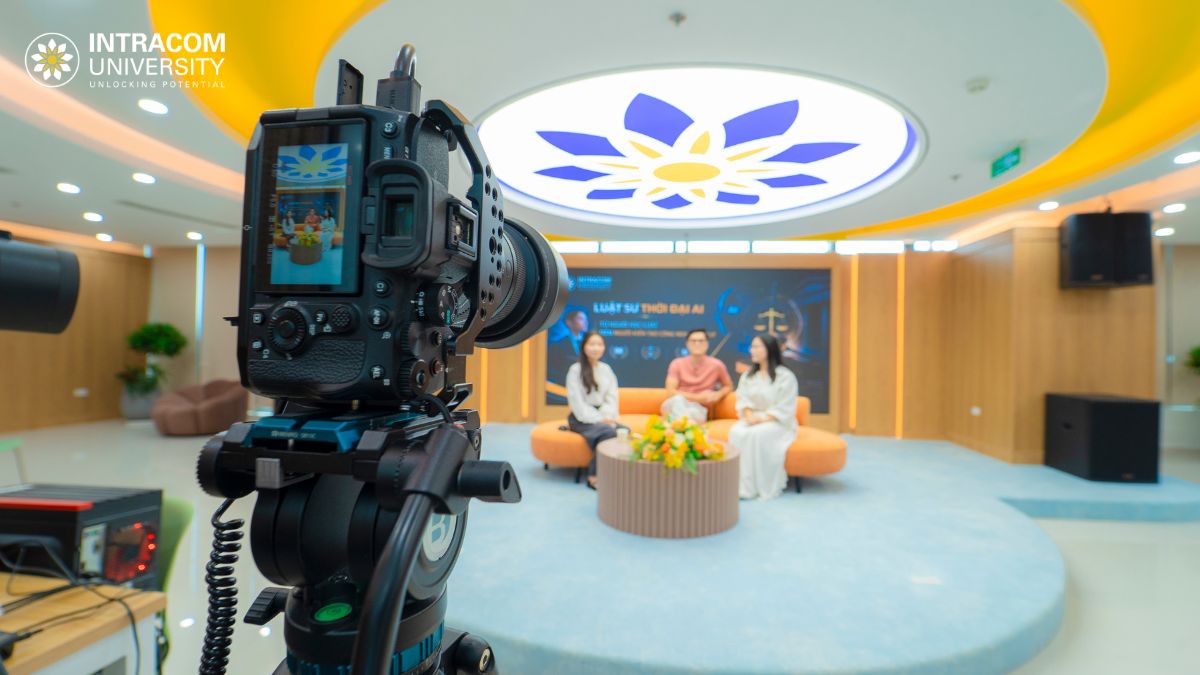
University is not only a place to receive knowledge, but also a stage for young people to gradually understand their profession, discover their own abilities and prepare for the real working environment. In that spirit, two livestream sessions of Intracom University opened face-to-face dialogues between schools and businesses, revolving around a question of interest to many 2K8 students: What kind of learning and experience do I need to study and experience so I can start working after graduation?
From the transformation of the Law profession in the age of artificial intelligence to the vivid picture behind an industrial construction project, the program not only helps viewers understand more about future careers but also points out the competencies students need to accumulate right from the first years of university.
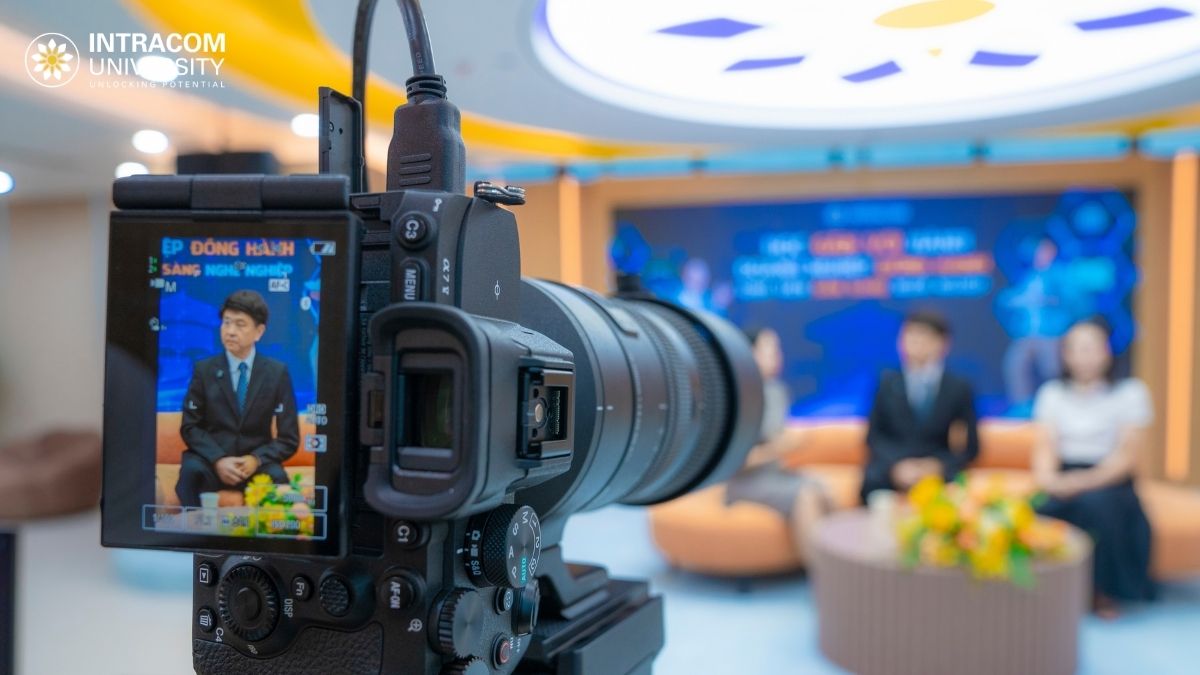
The first livestream session takes viewers into a rapidly changing professional space influenced by AI, data and legal technology. The program is led by Host Thanh Loan, and has the participation of MSc. Lawyer Duong Bao Trung – Chairman of LEXengine Joint Stock Company, co-founder of AI legal assistant platform LEXcentra and MSc. PhD student Trinh Minh Duyen – Lecturer at Faculty of Law, Intracom University.
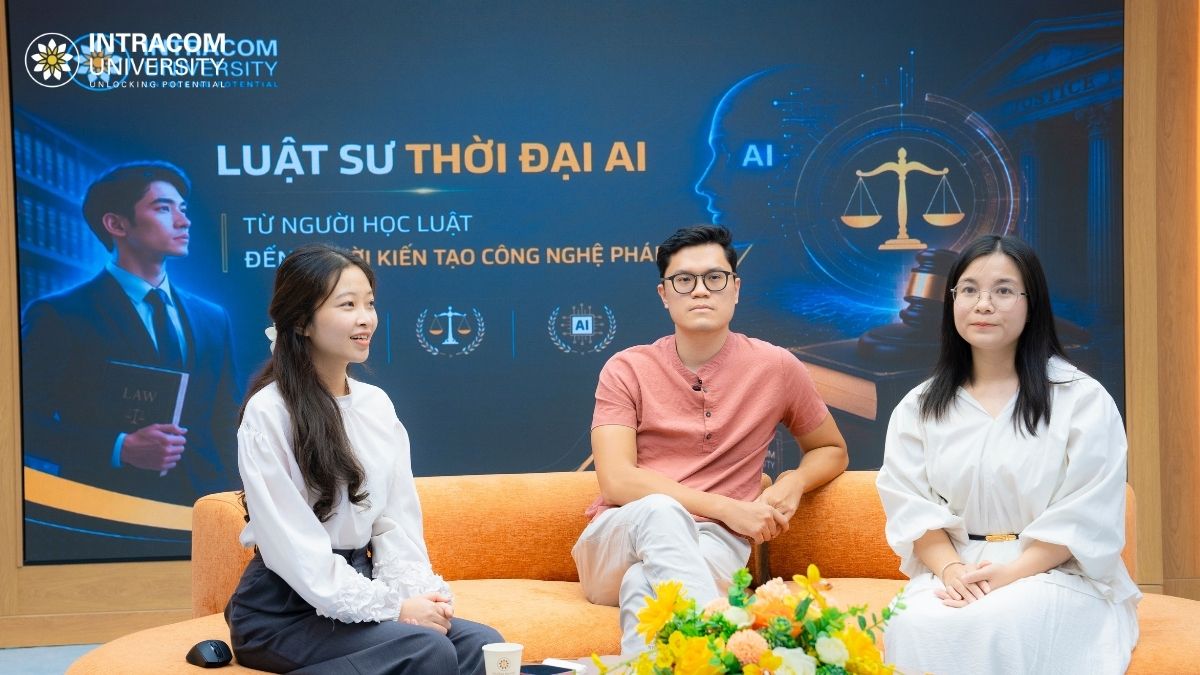
From personal experience, Lawyer Duong Bao Trung believes that very few students can imagine exactly what job they will do after many years. The important thing is not to immediately determine a career title, but to build fundamental competencies early: knowing how to read a structured problem, find grounds, make clear arguments and take responsibility for your conclusions.
Law does not only appear in courtrooms or thick files. Law is present in investment activities, governance, contracts, data, technology and almost every operational decision of a business. With an open mind, Law students can develop in many directions such as becoming a lawyer, corporate legal, compliance management, risk management, research, teaching or participating in building LegalTech products.
According to MSc. Trinh Minh Duyen, legal knowledge is still an indispensable foundation, but the ability to adapt, self-study, foreign languages and critical thinking determine how far young people can go. Technology will continue to change the way Law practitioners search and process information, but cannot replace professional responsibility, ethics and the ability to make human judgments.
One of the biggest gaps for students when entering the professional environment is the gap between understanding knowledge and the ability to create valuable products.
A legal study may be correct in theory but still does not meet the requirements if it is too long, lacks focus, does not point out risks or does not provide feasible solutions. Businesses not only need people who can find the law, but also need people who know how to put that regulation into specific situations, understand customers’ goals and turn research results into information for decision making.
For a student or intern, trust is often expressed from very basic things: being on time, clearly citing sources, not speculating when there is a lack of data, knowing how to ask questions, reporting early when risks appear and re-checking the product before sending.
From a training perspective, Intracom University orients Law students not to stop at memorizing regulations. Learners are trained through researching documents, solving situations, drafting documents and contracts, giving presentations, working in groups, mock trials and internships in each stage.
The goal of this process is not only to help students complete the course, but to create products that can demonstrate their abilities to employers.
The development of AI is helping Lawyers save significant time in searching, synthesizing, reviewing and creating drafts. However, the two guests agreed that AI should only be seen as a support tool, not the subject that makes the final decision.
A student who knows how to use AI is not simply asking a question and receiving an answer. Learners must know how to correctly determine the task, check the basis, detect missing data, compare the validity of the document and explain why they chose an option.
In the legal field, a wrong information, an expired document or a regulation applied to the wrong subject can all lead to significant consequences. Therefore, the ability to verify the source, evaluate the results and take responsibility for the final product is a mandatory requirement.
The livestream session also opened a new perspective on career opportunities for Law students in the field of legal technology.
To build and operate a LegalTech platform, businesses don’t just need AI engineers or data engineers. The team also needs people with legal knowledge to research, classify and standardize documents; validity check; develop a set of criteria; test results; Analyze compliance and translate business requirements into specific features.
That means Law students do not necessarily have to become programmers. However, you need to understand how technology works, have data discipline, and know how to coordinate with people of different expertise.
A portfolio of legal memos, reviewed contracts, compliance matrices, AI results validation logs or process improvement proposals can help students demonstrate their employability more clearly than just listing the courses they have taken.
To help viewers easily imagine, the program poses a situation where an intern is assigned to assist in reviewing service contracts.
Instead of uploading entire documents to an AI tool and waiting for an answer, practitioners must start by determining the contract type, transaction goals, business role and priorities.
AI can assist with regulatory searches, detecting clauses that require attention regarding scope of work, payment, liability, security, data, contract termination or dispute resolution. However, the learner must still examine the validity of the source, assess the level of risk, and translate the results into a clear professional product: what is the problem, where is the basis, what are the risks, and what options should be proposed.
Through this situation, the two guests affirmed that the difference does not lie in AI doing things for humans. Technology helps Lawyers process data faster so they have more time for higher value work such as analysis, communication and decision making.
In the face of rapid changes in the market, Intracom University aims to train Law students in the direction of strong legal knowledge, digital capabilities and meeting the actual needs of businesses.
Students not only study specialized modules but also gradually approach foreign languages, technology, artificial intelligence and working skills in the digital era. Learning is tied to specific products such as legal documents, contracts, research papers, case files, mock trials or internship results.
Through the companionship of businesses, learners have more opportunities to access data, tools and real career situations. Internship or project participation opportunities are implemented based on the plan, job requirements, number of positions and capacity of each student.
This is also a notable message for 2K8 students: you do not need to be good at Literature to study Law. Besides the ability to read and express, learners also need logical thinking, carefulness, the ability to ask questions and perseverance. Studying Law is not about memorizing all the laws, but knowing how to look up, analyze and apply the law to solve problems.
If the first session opened up a picture of the Law profession before the impact of AI, the second livestream session brought students closer to an industrial construction project and the people behind each project.
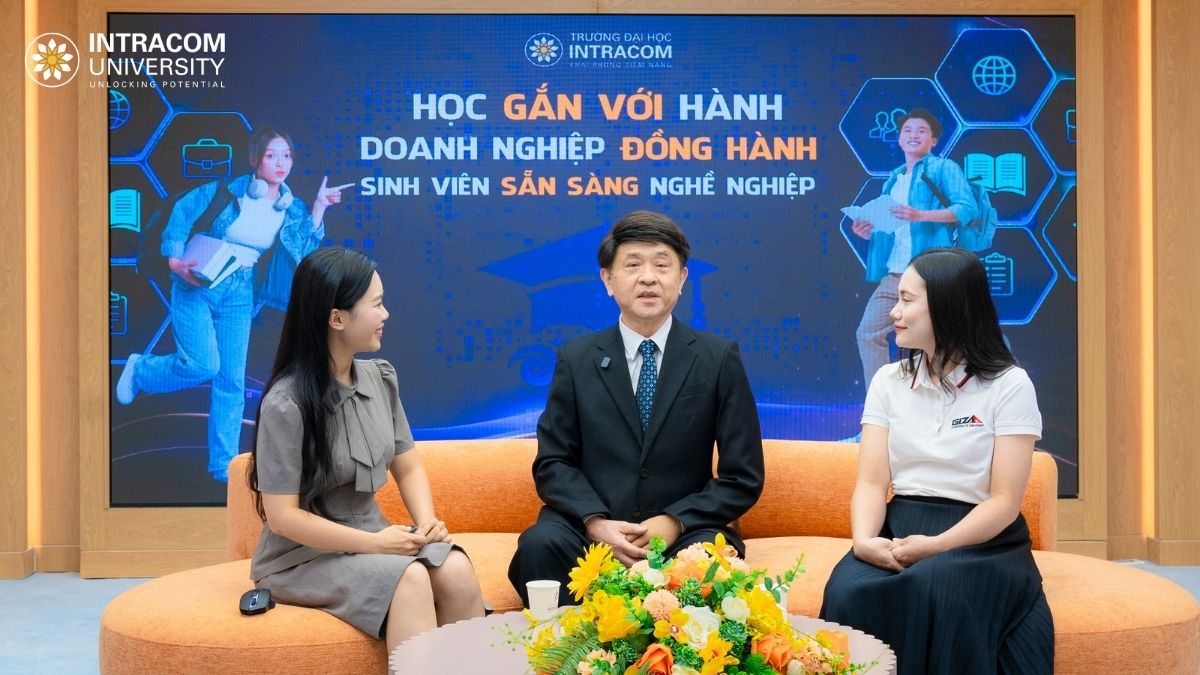
The program is coordinated by Host Linh Phuong, and also has the participation of Ms. Ngo Ngoc Van – representative of GIZA Group and Prof.Dr. Ngo Xuan Binh – Vice President of Intracom University. From the perspective of businesses and schools, two guests answered concerns about careers, the gap between study and work as well as the journey students need to prepare during four years of university.
Instead of starting with a list of vacancies, the livestream session helps viewers visualize the entire life cycle of an industrial factory project.
From receiving customer needs, the project must go through many stages such as survey, design, estimating, bidding, construction preparation, field deployment, controlling progress, quality, cost and safety before acceptance and handover.
Each stage requires the participation and coordination of many professional groups. Besides field engineers, there are also architects, structural engineers, infrastructure, mechanical and electrical engineers, BIM personnel, QS, estimating, bidding, contracts, quality management, project management, surveying and safety.
A project cannot operate without support departments such as finance – accounting, human resources, procurement, logistics, communications and interpretation.
This picture helps 2K8 students understand that studying construction does not mean just working on the construction site. Those who love technology, analysis, design, cost management or office work still have many suitable development directions. Competence, strengths and adaptability are more important than stereotypes about gender or the working environment.
From business experience, Ms. Ngo Ngoc Van pointed out that new graduates may be equipped with knowledge but still have difficulty applying it to specific projects.
New people may not be used to reading and checking drawings, not understanding project implementation procedures, lacking reporting skills or not knowing how to coordinate with other departments. Some students are afraid to ask questions, wait to be assigned work, or are unfamiliar with the strict requirements on progress, quality, and safety.
Those limitations do not mean students are weak, but reflect the natural gap between the classroom and the professional environment. This gap can be completely shortened if learners are exposed to work, receive instructions and feedback early.
Businesses also do not expect new graduates to know everything. What makes the difference is professional background, learning attitude, initiative, honesty about abilities and ability to improve after each feedback.
According to sharing at the program, a student can keep pace with the corporate environment when converging five groups of competencies.
First of all, the professional foundation to understand the nature of the problem. Next is the ability to use tools and turn knowledge into a product or solution. Besides, students must have a sense of responsibility, respect progress, quality and safety standards.
Communication, reporting and coordination skills are also especially important because a project is never completed by one individual. Finally, the ability to learn, receive feedback and adapt to changes at work.
Scores and certificates may partly reflect the learning process, but businesses are also interested in what candidates have done, how to handle problems and the attitude shown during the interview or trial work process.
A common belief is that students only need to do an internship until their final year. However, according to two guests, if you wait until this stage to start learning about the job, learners will easily be confused.
“Learning with practice” needs to be implemented as a continuous journey. In the early stages, students can listen to experts share, visit offices, businesses or construction sites to understand the profession. As they gain more knowledge, learners begin to access drawings, sample documents, software and appropriate project situations.
Internships and internships need to have clear instructors, job leads, deadlines and evaluation criteria. After each experience, students must know what they have learned, what is missing, and what needs to be changed. Only then will practice truly create capacity instead of just being a formal activity.
From the exchange content, a student’s university journey can be visualized through four stages of continuous development.
The first year is the time to understand the industry, understand the profession and understand yourself. Students need to build study discipline, foreign language and information technology foundation and proactively participate in career guidance activities, visits or exchanges with businesses.
In the second year, learners begin to get acquainted with tools, drawings, sample documents and professional situations. Classroom knowledge needs to be gradually transformed into exercises, products or problem-solving solutions.
The third year is a period of clearer contact with the working environment through internships or internships. This is also the time when students realize they are suitable for design, field, cost, technology or project management.
By the final year, learners need to aim for a state of readiness to join the business: participate in intensive internships, carry out real-life projects, complete CVs, portfolios and interview skills.
This roadmap shows that career readiness is not built in a short internship but is the result of preparation steps accumulated over the years.
During the training process, the school is responsible for building programs, providing foundation knowledge, ensuring output standards and organizing learning activities. Businesses provide career context, real-world standards, experts, project scenarios, experiential environments and direct feedback.
The cooperation between GIZA Group and Intracom University is oriented from helping students understand careers, develop capacity to connect with internship and recruitment opportunities when meeting requirements.
However, having more opportunities to approach businesses does not mean that students are automatically selected. The results also depend on each person’s plan, actual needs, evaluation criteria and training process.
Schools and businesses can open the door, but students must be the ones to proactively step through that door. Asking questions, receiving feedback, retaining products, and taking each experience seriously will determine whether opportunities are converted into capabilities or not.
Although exploiting two different fields, the two livestream sessions meet in the same message: students should not wait until graduation to start vocational training.
Law students need to know how to use and verify AI instead of depending on technology. Engineering students need to understand how a project operates instead of just studying individual specialized subjects. Regardless of which field they choose, young people need a professional foundation, digital skills, coordination ability, sense of responsibility and initiative in experiencing opportunities.
For 2K8 students, choosing a university is therefore not just about choosing a major or a degree. It is also the choice of an environment that helps me quickly understand the profession, be tested in real situations, be guided, criticized and gradually create products that prove my abilities.
When the classroom is connected to business, technology and real projects, four years of college are no longer just waiting for graduation. It becomes a journey of oriented preparation, so that each student enters the labor market with confidence and the ability to start work.

On December 12, 2023, the Party Committee of Chu Van An University solemnly organized the Party Admission Ceremony for 03 outstanding people who are officers and employees under Party Cell 1, including comrades: Hoang Nang Nam, Nguyen Thi Thanh Mai and Nguyen Bich Phuong.

Distance University is a form of online university training, allowing learners to access the curriculum without having to go to class in the traditional model. Instead of studying directly in the lecture hall, Intracom University students will study online through the University’s training platform system.

October 11, 2025, Workshop “Give wings to your dreams – Study abroad in China in 2026” organized by QTEDU coordinate with Intracom University (Formerly Chu Van An University) the organization took place successfully in a solemn and vibrant atmosphere in Hanoi.

In the journey of choosing the future, having access to accurate admission information and clear career orientation plays an extremely important role for senior students. In order to accompany students in this key stage, the Working Group of the Admissions and Student Affairs Department in collaboration with the Training and Voc…

In the training orientation associated with practice, Intracom University Continuously organize experiential activities to help students expand their knowledge, nurture civic thinking and a sense of social responsibility. One of those meaningful activities is the tour Vietnam National Assembly Building and Presidential Palace re…

On October 27, 2023, Center for Professional Training and Practice – Intracom University attended and spoke at the Scientific Conference “Promoting connection, dissemination and sustainability in Legal Practice Education in Vietnam” organized by National Economics University in collaboration with Foreign Trade University and BAP…

Guilin University of Electronic Technology (GUET) Established in 1960, GUET is a key public university in Guangxi (China). This is a multidisciplinary university, with outstanding strengths focusing on the fields of engineering, information technology and electronic technology, while expanding training to many fields of applied…